Referral Follow-Through
A shared way to see the step after the referral.
When an officer at a domestic-violence call offers to connect someone with a local service provider, Mississippi already records a good deal of what happens. What we couldn't find anywhere is the next step: did the provider get it, and if not, whose job is it to check? This concept sketches a simple, shared vocabulary for that step. It isn't a new app.
See the five states ↗An Advanced Magnolia concept. Not in use anywhere.

People. Partnerships. Possibility.
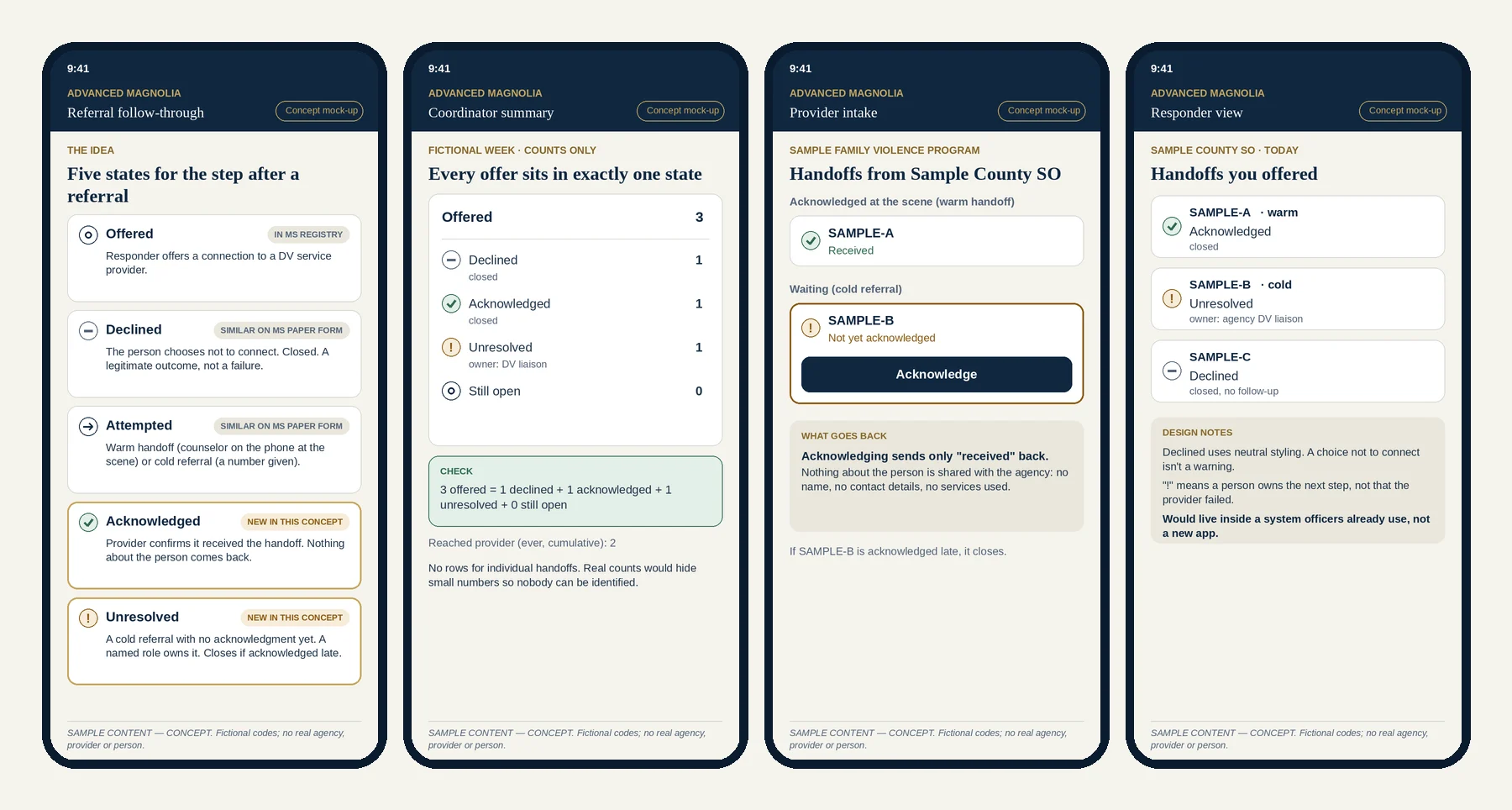
Five states. Two of them are new.
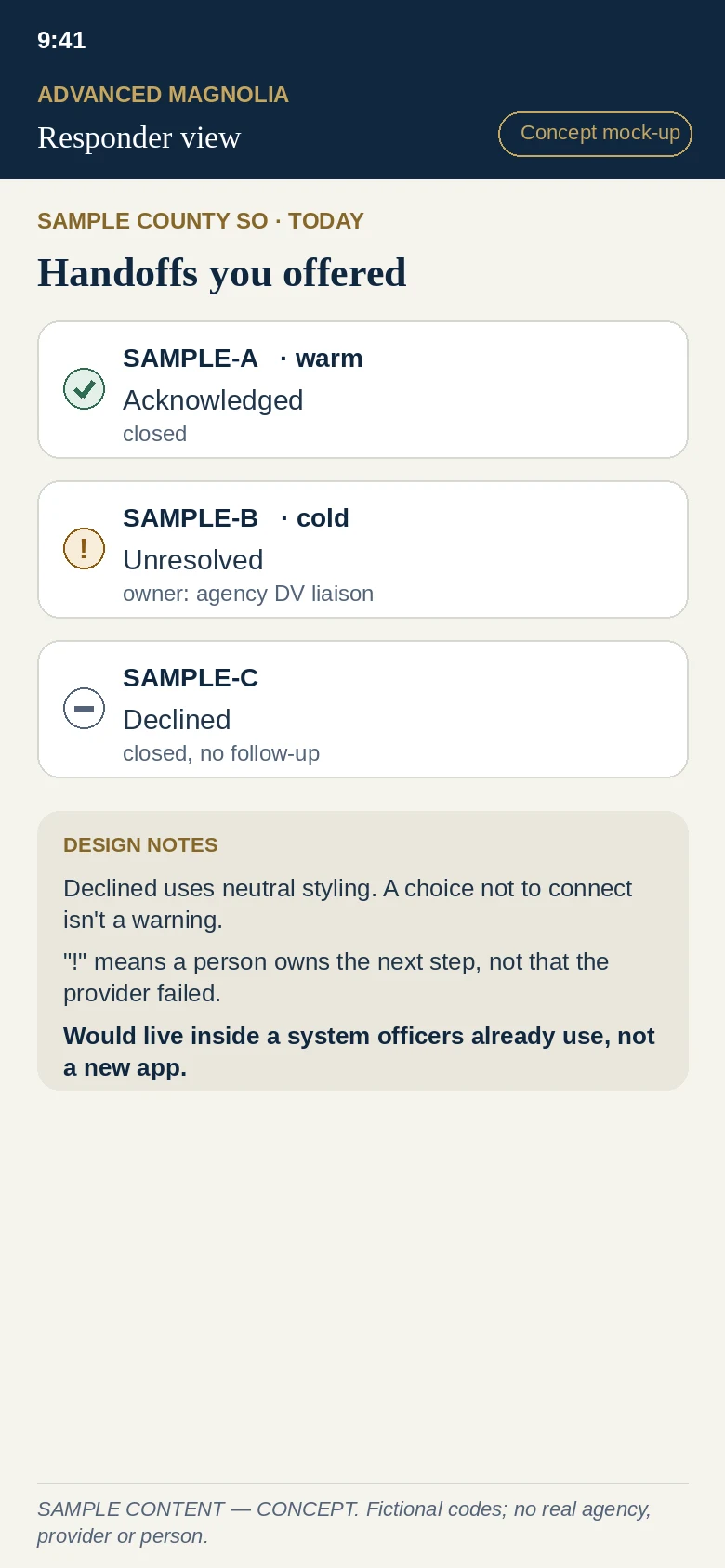
Three sample handoffs from one fictional shift.
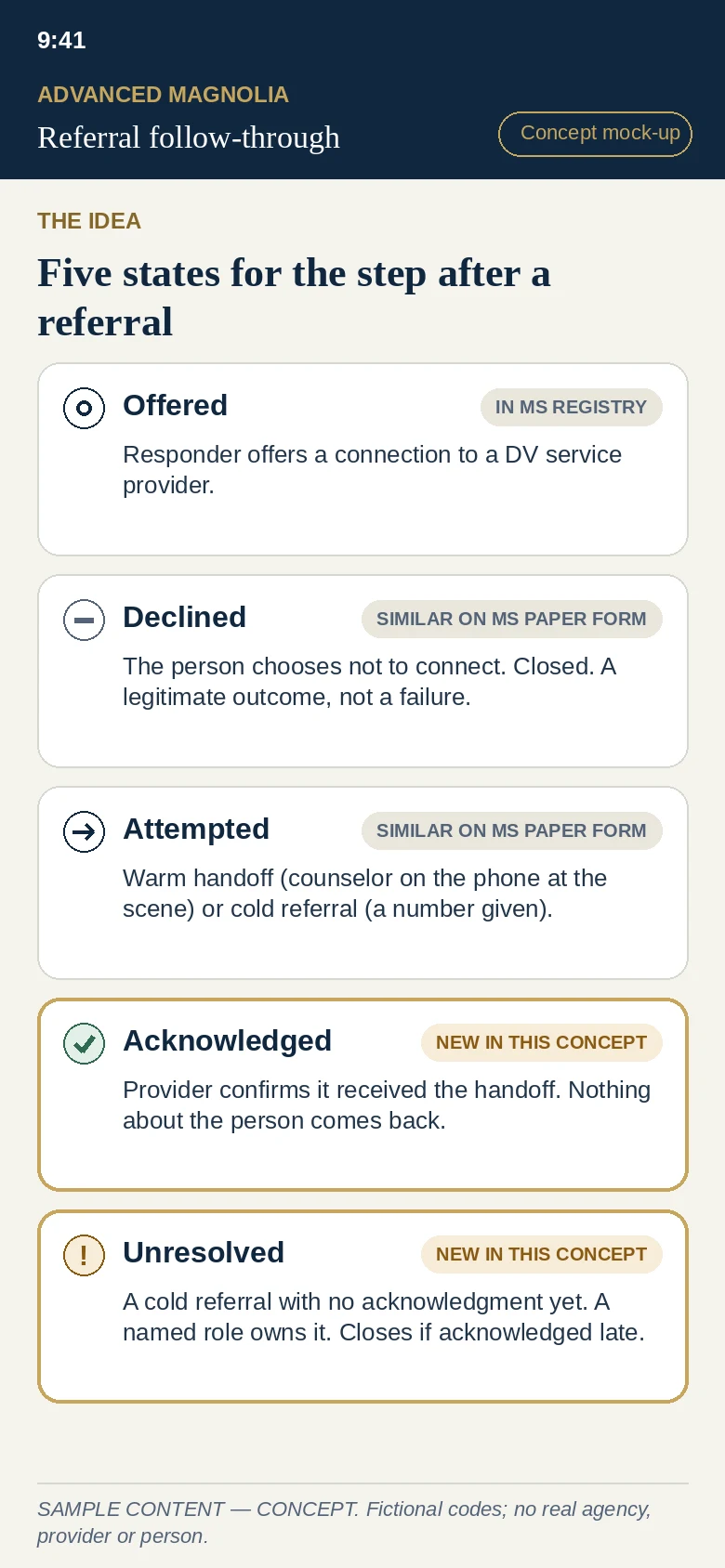
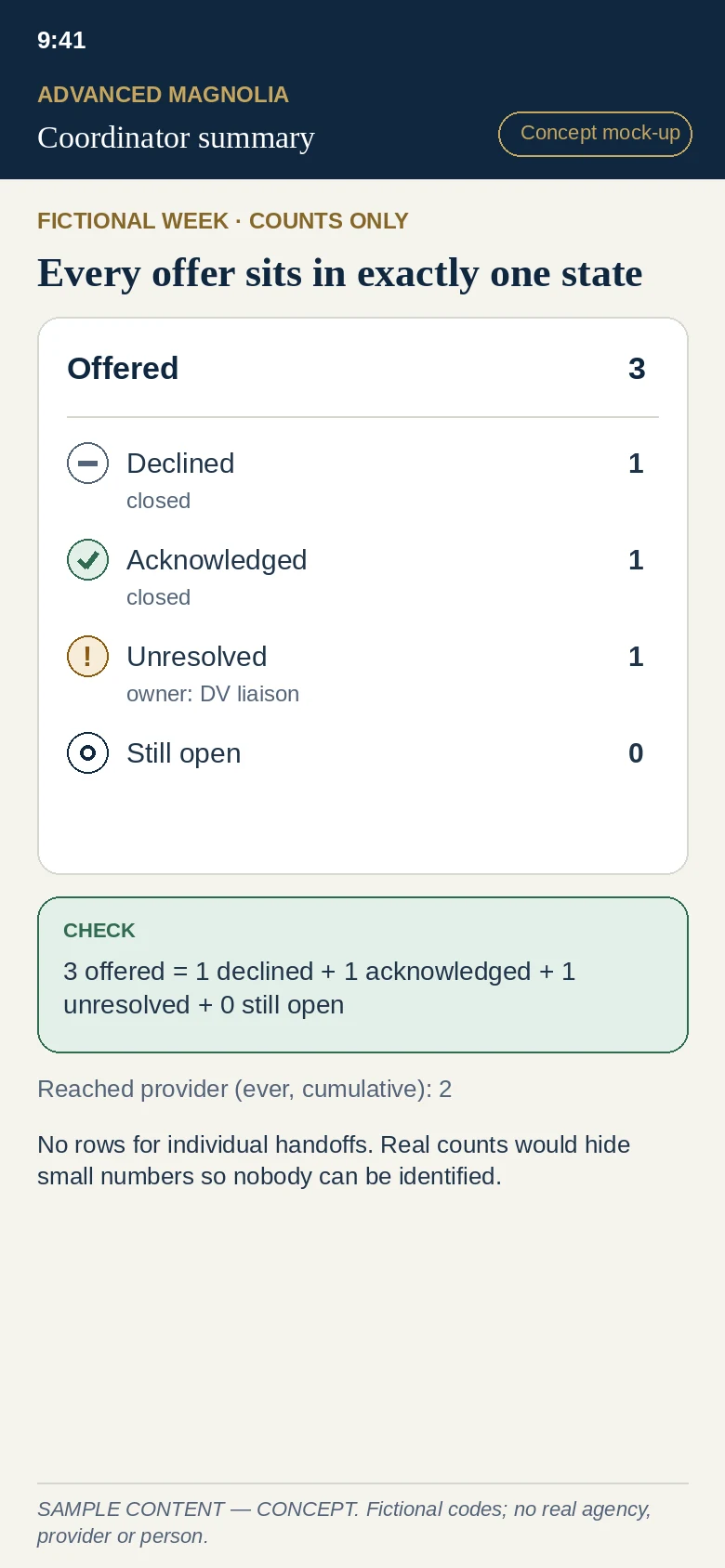
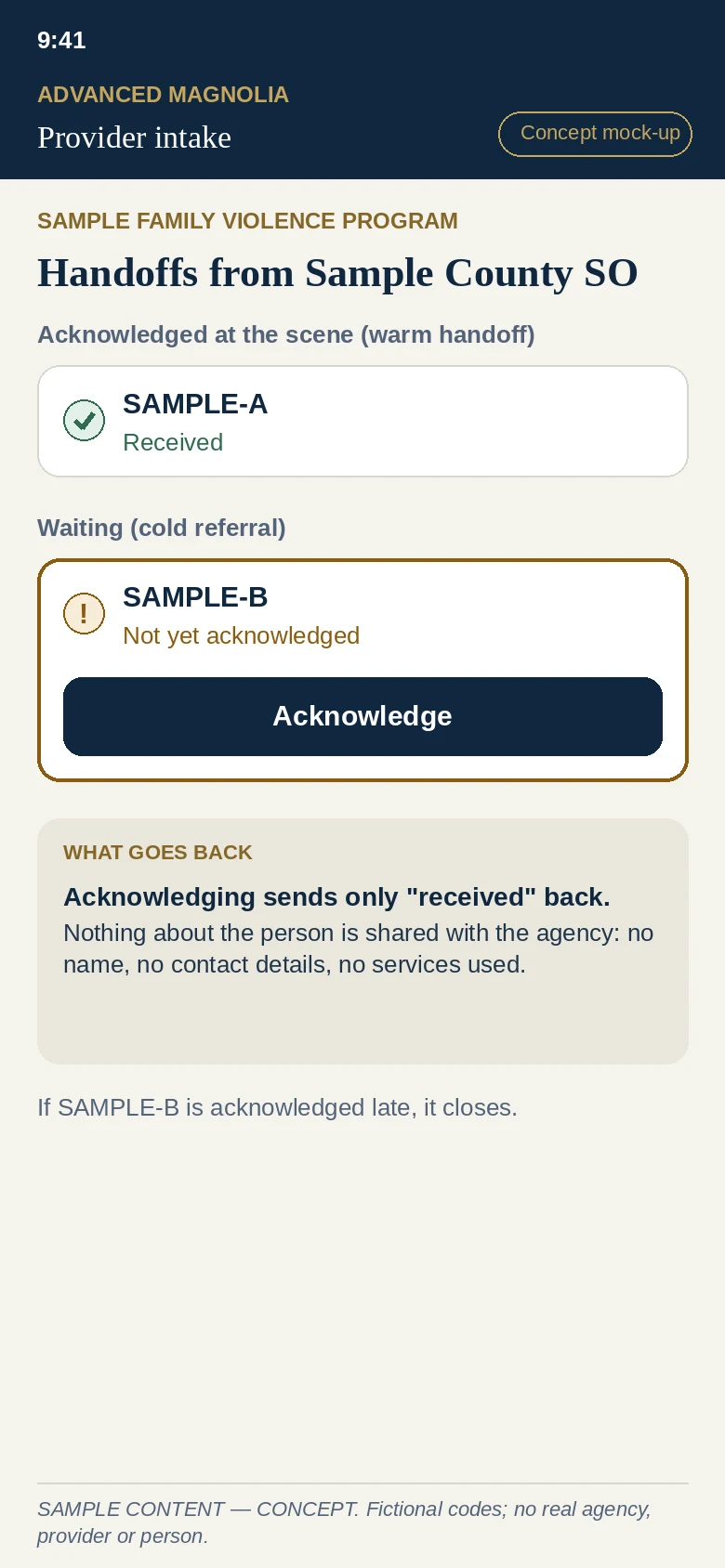
At a made-up sheriff's office, an officer offers three people a connection to a made-up family-violence program. The first takes it, and the officer puts a counselor on the phone right there, so the handoff is received on the spot. The second gets a number to call, and the program hasn't confirmed anything a day later. That one now has a named owner, the agency's DV liaison, and it closes if the program confirms late. The third says no thanks. That's closed too, and it's shown the same calm way as the first. Choosing not to connect isn't a failure.
Say it once, confirm it, count it.
- 01 / NAME THE STATES
Offered, Declined, Attempted, Acknowledged, Unresolved. Mississippi's registry already records when a referral is made, and the paper lethality screen covers rough equivalents of the next two. Acknowledged and Unresolved are the new pieces.
- 02 / SEND BACK ONE WORD
When a provider confirms, the only thing that goes back is "received" on a random reference code. No name, no contact details, nothing about whether the person used services.
- 03 / COUNT, DON'T LIST
Coordinators see counts that add up: every offer sits in exactly one state. There are no case lists, and small numbers would be hidden so nobody can be picked out.
Most of this is already being recorded.
- Mississippi's domestic-violence registry asks officers whether the lethality questions were asked and whether a referral was made (MSDVR user guide, p. 20).
- The state's lethality screen records whether the person was connected to services and whether they spoke with a counselor. It's a separate paper form that isn't attached to the registry report (MSDVR LAP form).
- A Mississippi-built platform, the Domestic Violence Lethality Assessment Platform, describes itself as helping agencies and community partners "carry out lethality assessments and streamline the sharing of critical information with service providers" (its public page).
That's why this concept is a shared definition, not new software. If it were ever useful, the natural home would be a system officers already use.
Before anything gets built.
- After a referral is offered, does anyone on the response side need to know the provider received it?
- Does the registry, or the platform agencies already use, record that today?
- Is the rural problem only devices, or also training and entering the same call twice?
- Would counts of offered, connected and declined help with reporting, or just add work?
- Who should own a stalled handoff, if anyone?
Those answers come from conversations with the people who run this work. We haven't contacted anyone.
Small print: This is a concept. It hasn't been reviewed by a domestic-violence advocate or a provider's confidentiality counsel, tested with any agency, or evaluated. Whether a "received" signal could ever be shared is a legal question for providers, and the idea stops if the answer is no. It isn't affiliated with or endorsed by the Mississippi Attorney General's Office, the Mississippi Coalition Against Domestic Violence, the Center for Advanced Public Safety, R. Luke Thompson, LLC or any other organization named here.
Clear about the next step.
The aim is a next step that's easy to see and has an owner, and that respects a person's choice and keeps their information where it belongs.
Start a conversation.
Contact Advanced Magnolia ↗