Online Safety, Together
Short, practical lessons for parents and caregivers on what to watch for online, how to talk about it and what to switch on.
Parents in Mississippi have more online-safety tips than ever. What's often missing is a short path from noticing something to doing something, and a way to tell whether the lesson stuck. We're exploring a four-part phone series, about 35 minutes in total, built around that path. Part 1 can be done on its own; the other parts and a refresher work best when a school or group sends them a week or so apart.
See the lesson concept ↗A concept from Advanced Magnolia.

People. Partnerships. Possibility.
Four short parts. One clear next step each time.
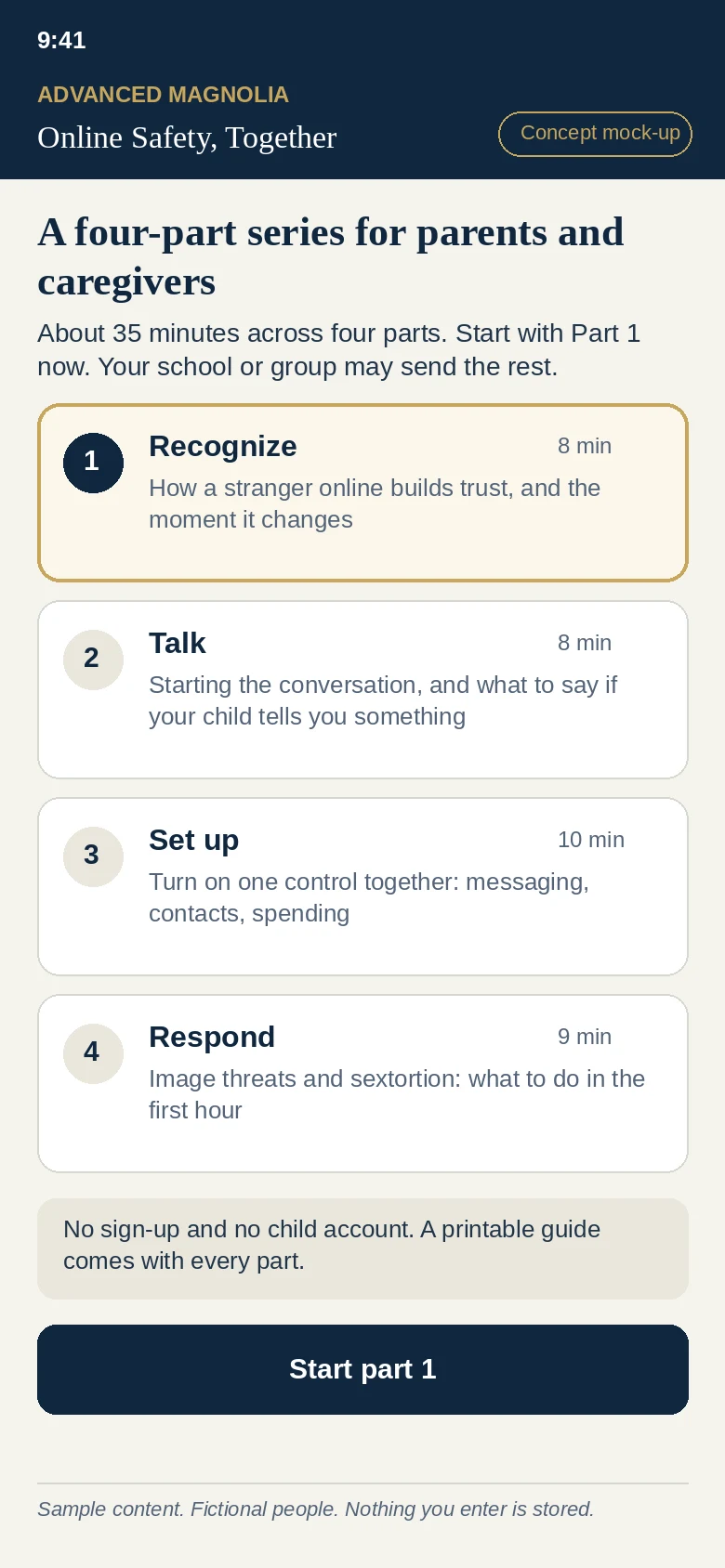
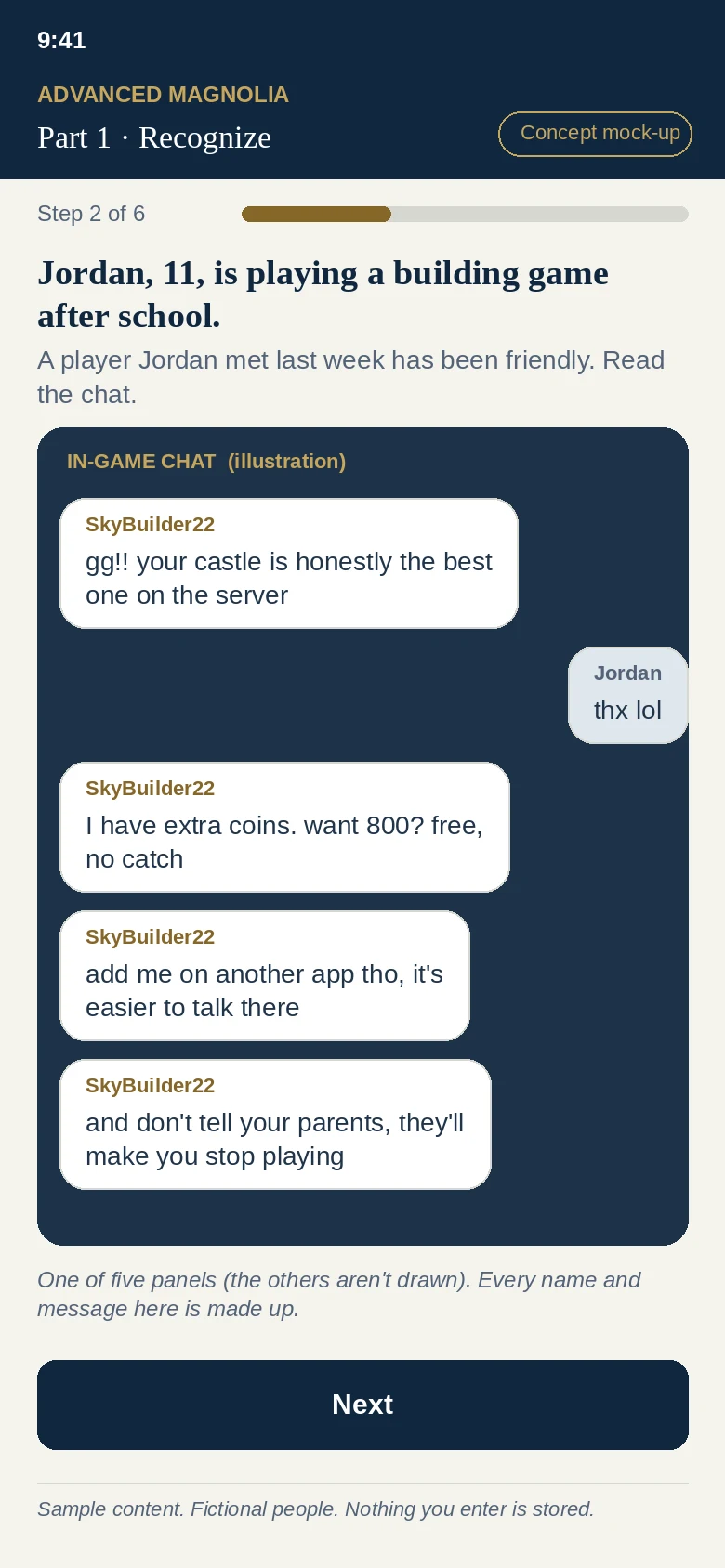
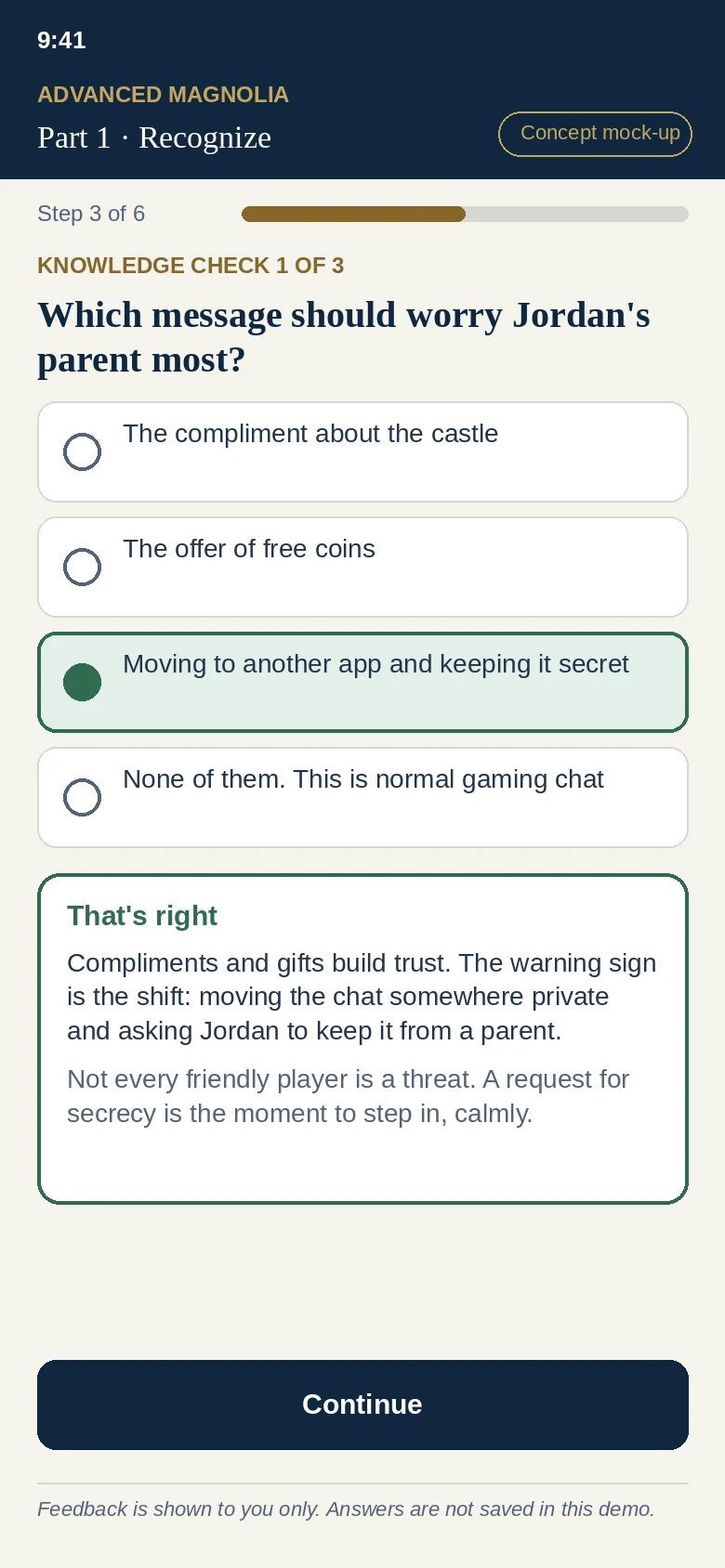
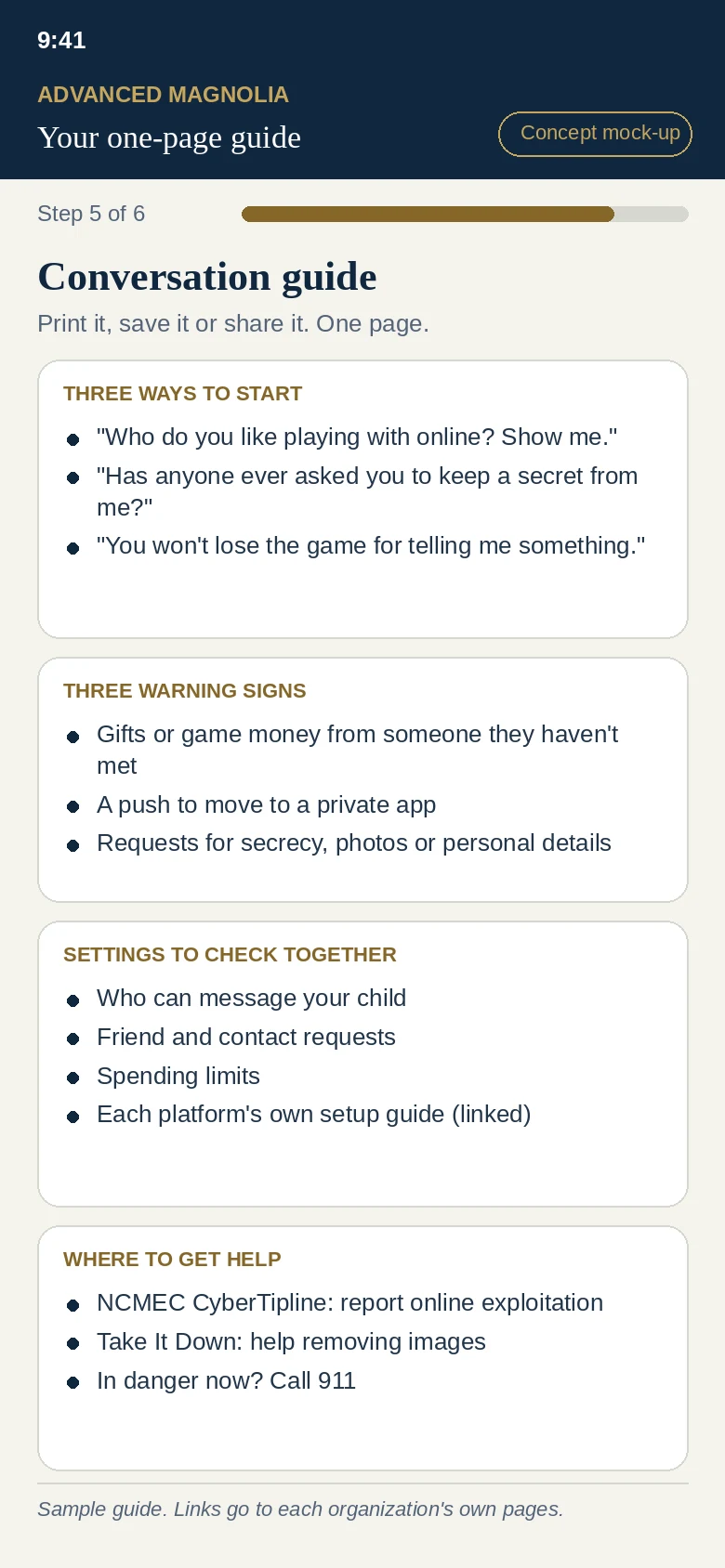
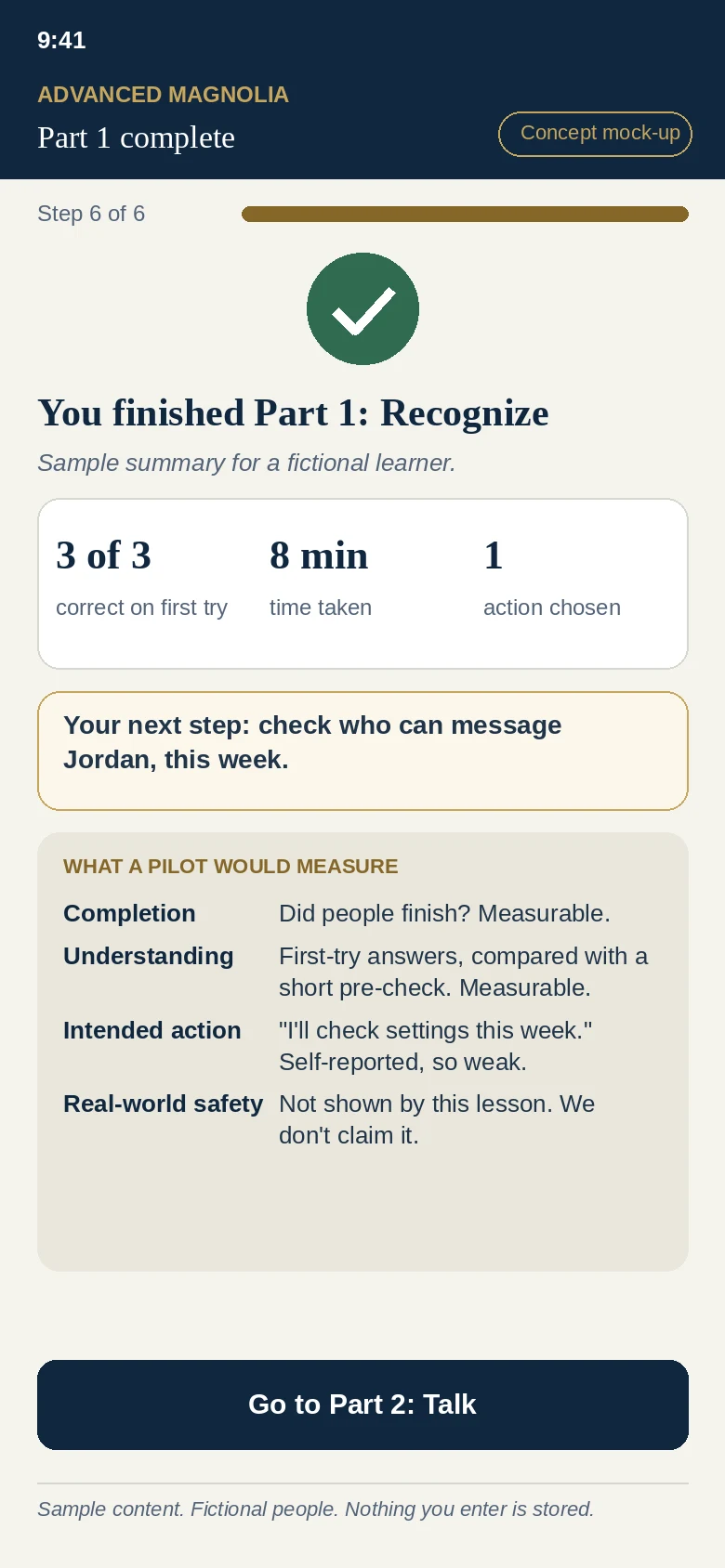
A friendly player. Then a request to move somewhere private.
In the sample lesson, a made-up 11-year-old named Jordan gets compliments and free game coins from another player. Then come "add me on another app" and "don't tell your parents." The lesson asks the parent to spot that shift, choose a calm first thing to say and check one setting. It takes about eight minutes, and nobody signs up.
Learn it, talk about it, set it up.
- 01 / RECOGNIZE
See the shift. Short illustrated scenarios show how trust gets built online and the moment it turns: a move to a private app, a request for secrecy.
- 02 / TALK AND SET UP
Have the conversation, then change one setting together. The lessons offer opening lines that don't shame anyone, and they link to each platform's own setup guide instead of repeating steps that go out of date.
- 03 / RESPOND
Know the first hour. If images are ever threatened, the guide is clear: don't pay, keep the evidence, and report to NCMEC's CyberTipline and Take It Down. These are links to NCMEC's own services. Advanced Magnolia isn't affiliated with NCMEC. Links last checked 2026-11-12.
Designed around published prevention guidance.
Proposed curriculum: four parts, about 35 minutes in total.
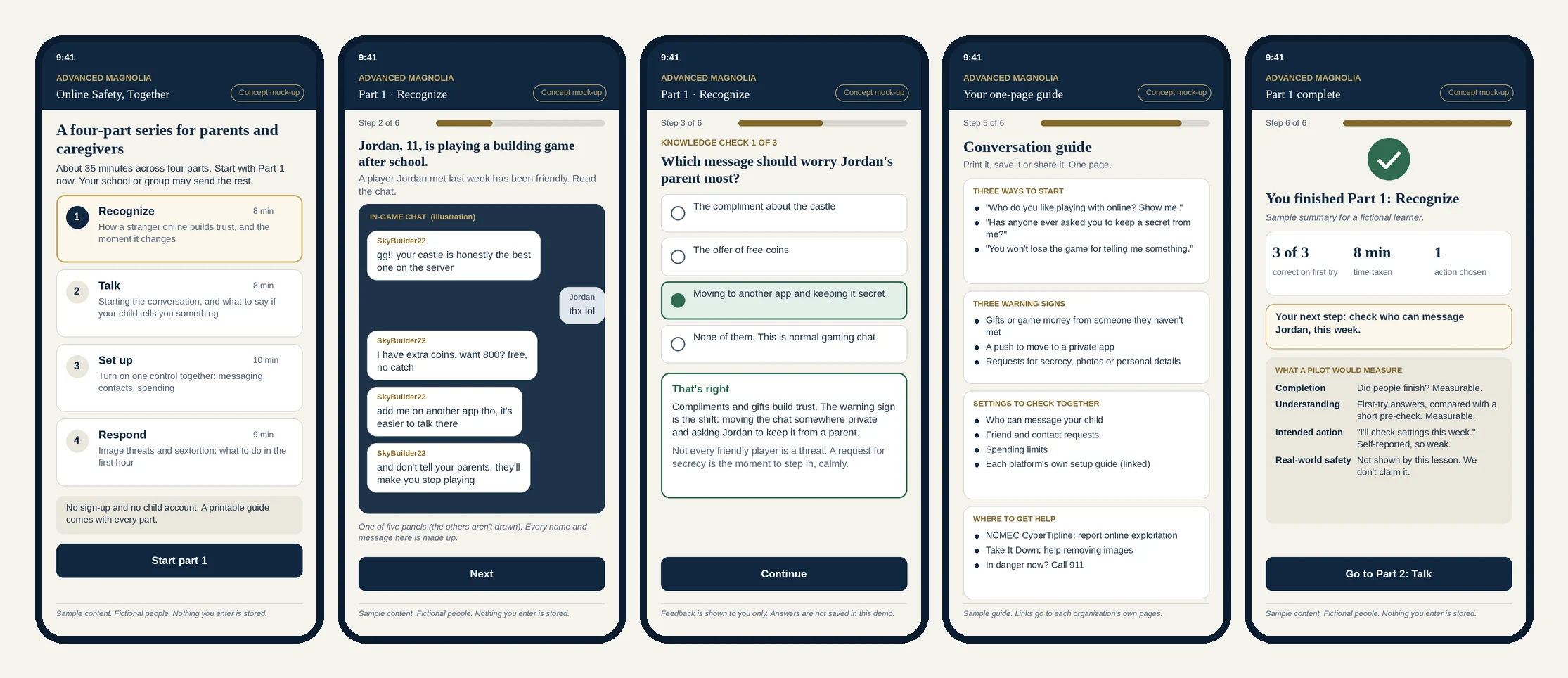
- Recognize · 8 minutes. How a stranger online builds trust, and the moment it changes
- Talk · 8 minutes. Starting the conversation, and what to say if your child tells you something
- Set up · 10 minutes. Turn on one control together: messaging, contacts, spending
- Respond · 9 minutes. Image threats and sextortion: what to do in the first hour
The four parts are Recognize, Talk, Set up and Respond. A facilitator guide lets a school counselor run Part 1 live at a parent night, then send the other three parts home a week apart and a three-minute refresher a month later. Without someone sending the parts, a parent can still take them, just not spaced out. The design draws on published prevention research and child-safety guidance: the KEEP checklist from a 2013 NIJ-funded study, NCMEC's parent tip sheets and Darkness to Light's five steps. That research says one-off lessons aren't enough, and that scare tactics don't work. The closest study on adults, a randomized trial of a brief child-abuse-prevention training for childcare workers, found gains in knowledge and in what people said they did. It wasn't about online safety, so we treat it as encouraging, not as proof. Most of it was written for programs aimed at young people, so applying it to adults is our adaptation.
Each part ends with a one-page take-home. A pilot would measure two things: whether people finish and whether they understand. Whether children end up safer is a bigger question this kind of lesson can't answer alone, and we don't claim it.
Small print: This is a concept. The curriculum hasn't been reviewed by a subject-matter expert, tested with families or evaluated. It isn't affiliated with or endorsed by the Mississippi Attorney General's Office, the Mississippi Department of Education, NCMEC, Roblox or any other organization named here.
Help that fits the moment.
The aim is guidance a parent can finish on a phone, remember and act on, alongside the resources Mississippi families already have.
Start a conversation.
Contact Advanced Magnolia ↗