Counting Convention
Two true numbers shouldn't look like a mistake.
Public counts of human-trafficking cases often come from several places. One is a running total since a task force began. Another covers a single year for a single unit. One counts related charges and the other doesn't. Both are right, but nothing on the page says so, and readers end up comparing numbers that were never meant to match. This concept is a shared way of saying how you count. It isn't a new reporting system.
See how two counts differ ↗An Advanced Magnolia concept. Not in use anywhere.

People. Partnerships. Possibility.
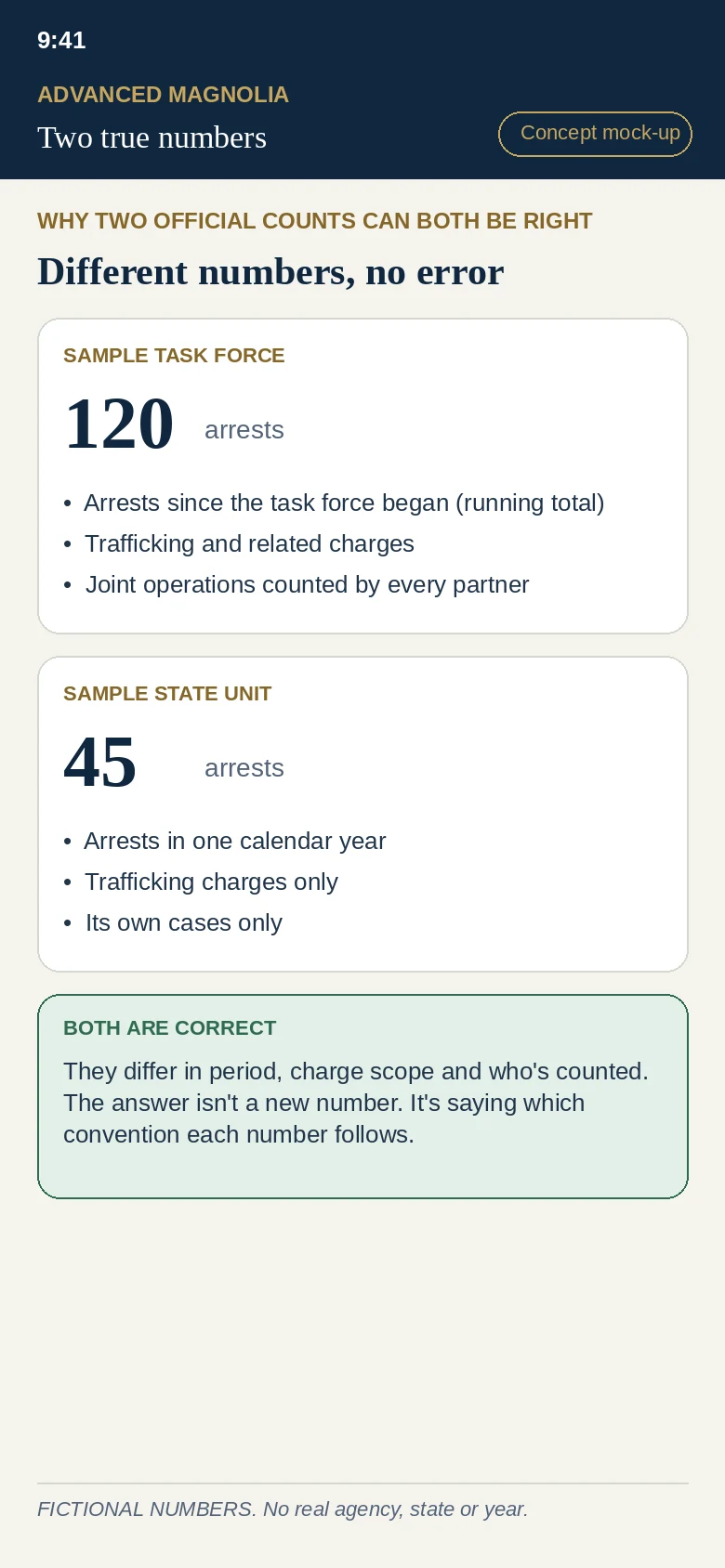
Different numbers, no error.
Read this screen as text
Mock-up comparing two fictional arrest counts. A sample task force reports 120 arrests as a running total, including related charges and joint operations counted by every partner. A sample state unit reports 45 arrests in one calendar year, trafficking charges only, its own cases only. A note says both are correct.
Say how you count. Then check before you publish.
Read this screen as text
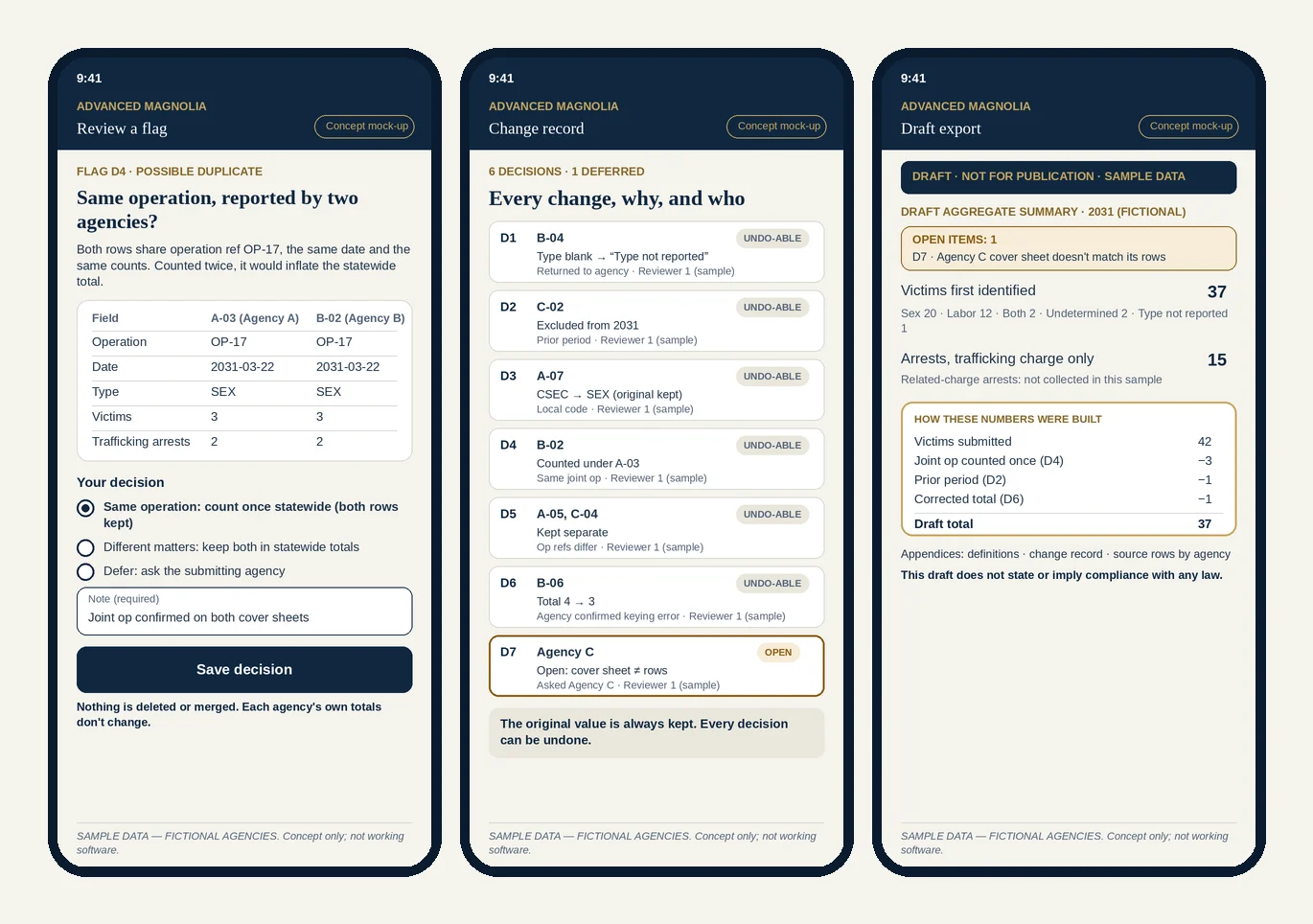
"Review a flag." Flag D4, possible duplicate. "Same operation, reported by two agencies?" Both rows share operation ref OP-17, the same date and the same counts.
| Field | A-03 (Agency A) | B-02 (Agency B) |
|---|---|---|
| Operation | OP-17 | OP-17 |
| Date | 2031-03-22 | 2031-03-22 |
| Type | SEX | SEX |
| Victims | 3 | 3 |
| Trafficking arrests | 2 | 2 |
Decision options: same operation, count once statewide (both rows kept), selected; different matters, keep both; defer, ask the submitting agency. Required note: "Joint op confirmed on both cover sheets." "Nothing is deleted or merged. Each agency's own totals don't change."
Read this screen as text
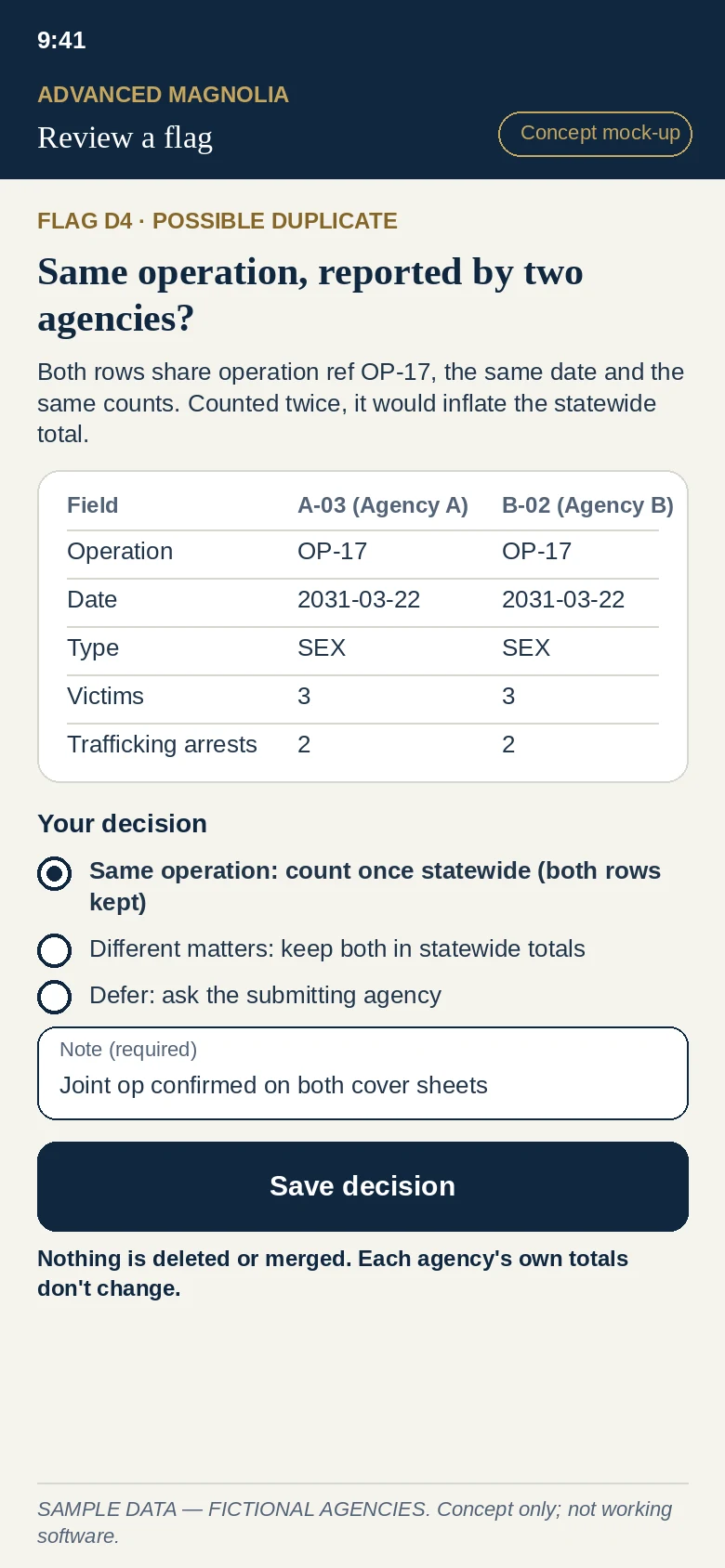
"Change record," 6 decisions, 1 deferred.
| ID | Row | Change | Reason | Status |
|---|---|---|---|---|
| D1 | B-04 | Type blank → "Type not reported" | Returned to agency | Can be undone |
| D2 | C-02 | Excluded from 2031 | Prior period | Can be undone |
| D3 | A-07 | CSEC → SEX (original kept) | Local code | Can be undone |
| D4 | B-02 | Counted under A-03 | Same joint operation | Can be undone |
| D5 | A-05, C-04 | Kept separate | Operation refs differ | Can be undone |
| D6 | B-06 | Total 4 → 3 | Agency confirmed keying error | Can be undone |
| D7 | Agency C | Cover sheet doesn't match rows | Asked Agency C | Open |
"The original value is always kept. Every decision can be undone."
Read this screen as text
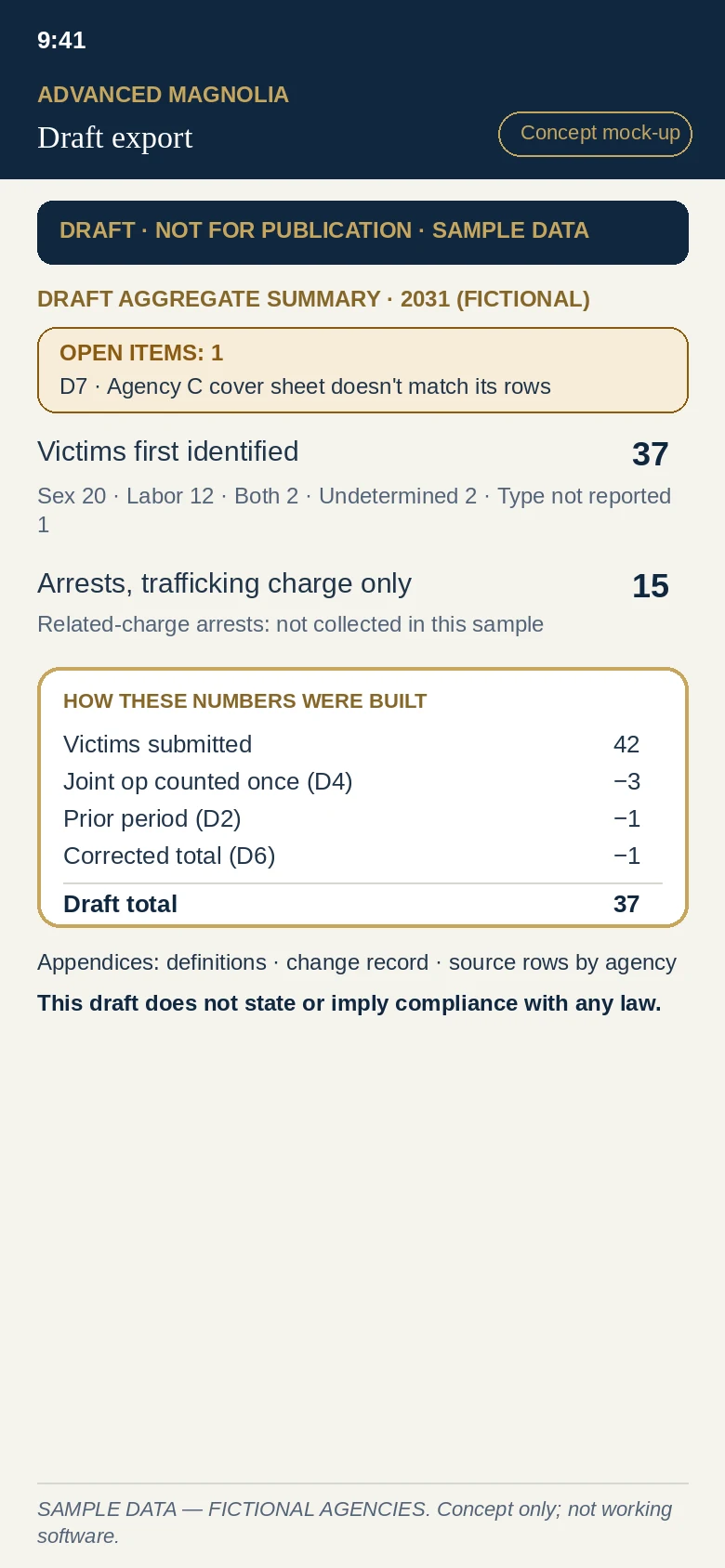
"Draft export." Banner: "Draft. Not for publication. Sample data." Draft aggregate summary, 2031 (fictional). Open items: 1 (D7, Agency C cover sheet doesn't match its rows). Victims first identified: 37 (sex 20, labor 12, both 2, undetermined 2, type not reported 1). Arrests, trafficking charge only: 15; related-charge arrests not collected in this sample. How these numbers were built: 42 victims submitted, minus 3 (joint operation counted once, D4), minus 1 (prior period, D2), minus 1 (corrected total, D6), equals 37. Appendices: definitions, change record, source rows by agency. "This draft does not state or imply compliance with any law."
One fictional year, three made-up agencies.
Three sample agencies send in their counts for a reporting year. Two of them worked the same operation and both reported it. A quick check flags the pair, and a reviewer confirms it's one operation, so it counts once in the combined total and stays in each agency's own numbers. Nothing is deleted. Another pair looks identical but turns out to be two different operations, so they stay separate. That's why nothing is merged automatically. A row from the prior year is set aside, one local category code is mapped to the shared one, and one agency's cover sheet doesn't match its rows, so that question goes back to the agency and stays open. The draft that comes out says what's still open, which arrest count it uses, and exactly how 42 submitted victims became 37.
Define it once, count it once, show your work.
- 01 / A SHARED CONVENTION
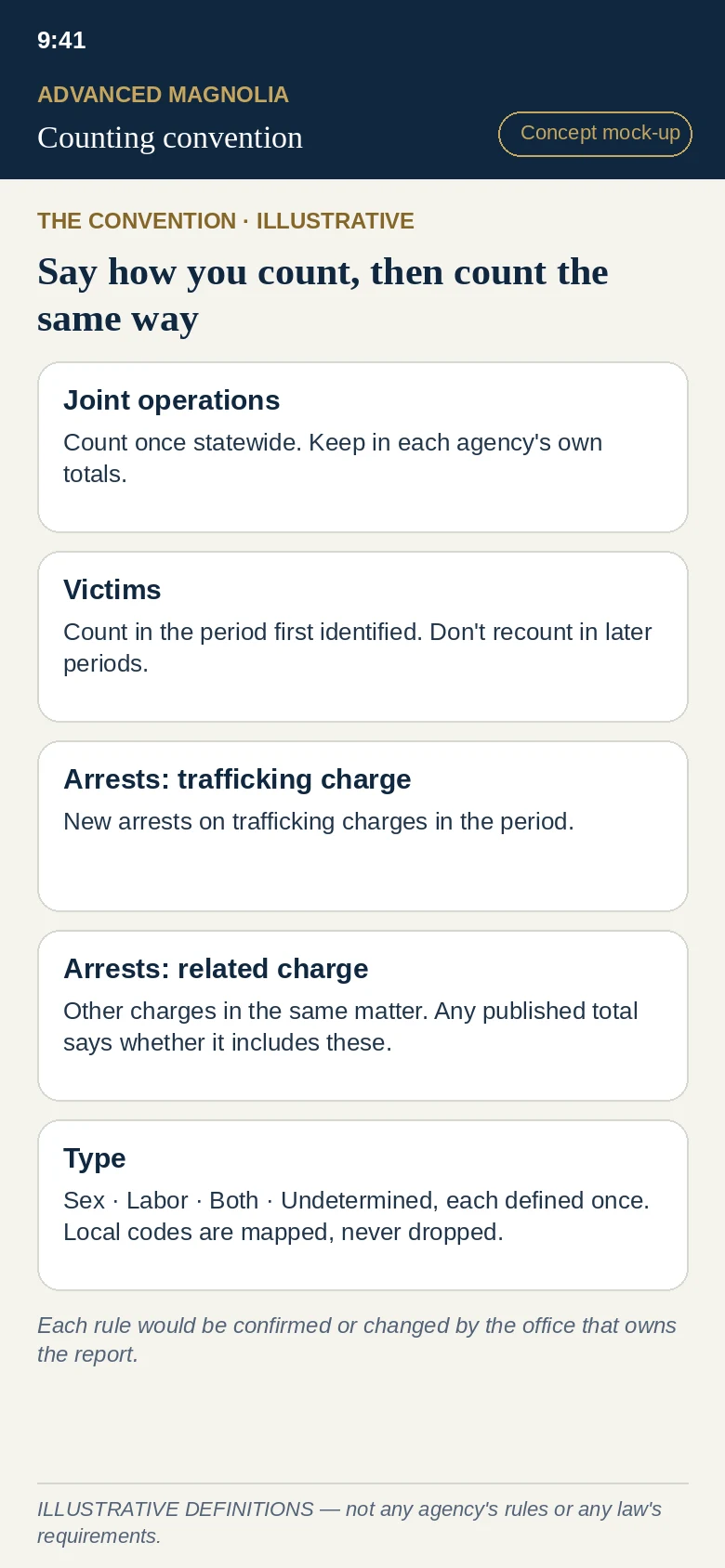
A few plain rules everyone uses: a joint operation counts once in the combined total; a victim is counted in the period first identified; arrests come in two defined counts (trafficking charges, and related charges), and any published total says which it includes.
- 02 / CHECKS A PERSON DECIDES
Missing fields, dates outside the period, unknown categories, possible duplicates and totals that don't add up are flagged with a sentence explaining why. A reviewer decides each one and writes a short note. Flags are questions, not verdicts.
- 03 / A DRAFT THAT SHOWS ITS WORK
Every change keeps the original value and can be undone. The draft lists open items first, appends the definitions, and shows the arithmetic from what was submitted to what's reported.
The rules, on one card.
Read this screen as text
Mock-up of five illustrative counting rules: joint operations count once statewide but stay in each agency's totals; victims count in the period first identified; arrests on trafficking charges; arrests on related charges, with any published total saying whether it includes them; and four defined trafficking types, with local codes mapped rather than dropped.
Most of the pieces are already out there.
- Federal task-force performance measures already define arrest and victim categories, and ask for "new" counts in each period.
- The FBI's national incident reporting has had offense codes for commercial sex acts and involuntary servitude since 2013.
- Ordinary spreadsheets can already enforce most of these checks with drop-downs, required cells and totals.
That's why this concept is a convention and a template first. Software would only make sense if a reporting office said spreadsheets weren't enough.
Before anything gets built.
- Where do the combined counts come from today, and who adds them up?
- Which counting rules does each source already follow, even if they aren't written down?
- Is a shared template something contributors would actually use?
- Which differences cause real follow-up work, and which only confuse readers?
- Who would keep the definitions current?
Those answers come from conversations with the people who do this work. We haven't contacted anyone.
Sources for the section above: federal task-force measures, OVC ECM law-enforcement questionnaire, June 2025; FBI trafficking data collection since 2013, BJS, Human Trafficking Data Collection Activities, 2022.
Small print: This is a concept. It hasn't been reviewed by any reporting office or counsel, tested with any agency, or evaluated. The definitions are illustrative. It doesn't collect or show any information about real people or cases. It isn't affiliated with or endorsed by any government agency or other organization.
Clear about what the numbers mean.
The aim is published counts that say how they were made, so two true numbers can sit side by side without looking like a mistake.
Start a conversation.
Contact Advanced Magnolia ↗